
I'm a Nurse. I See Skin Fold Rashes Every Shift. The Treatment Protocol Hasn't Changed Since I Started — and That's a Problem.

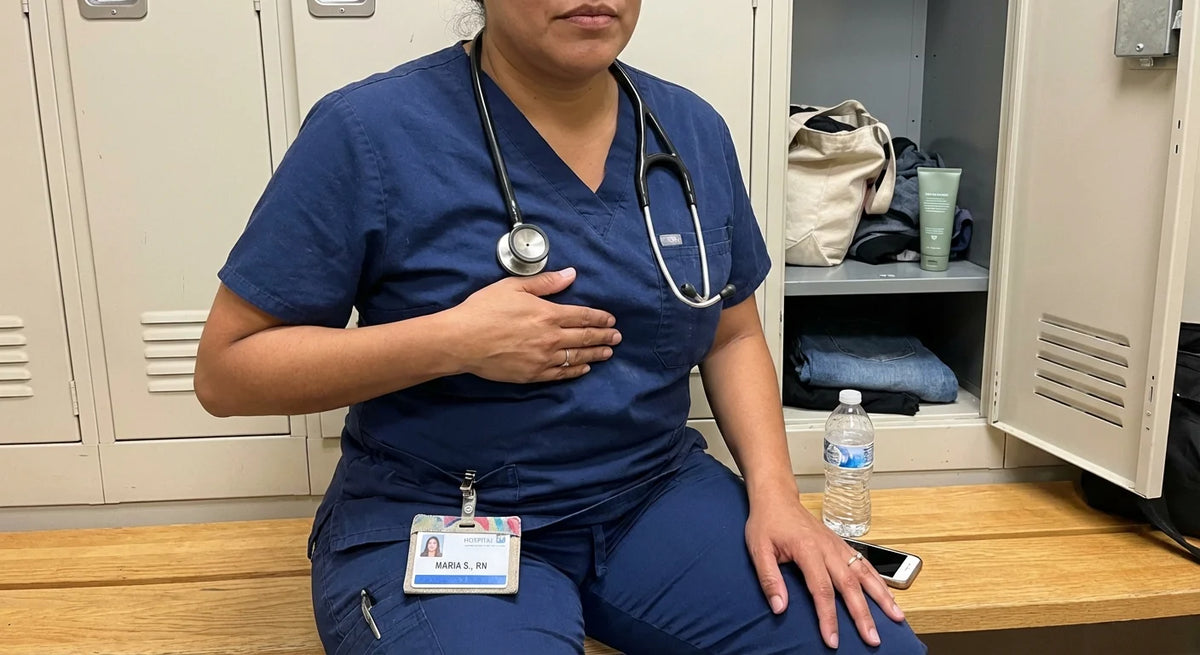
I need to be honest about something.
I'm a registered nurse. I've worked med-surg and ER for 14 years. In that time, I've seen skin fold rashes — intertrigo — on thousands of patients. Under breasts. Along belly folds. In the groin. On women of every size, every age, every background.
And in 14 years, the treatment protocol hasn't changed once.
Nystatin. Maybe Lotrimin. "Keep it clean and dry." That's it. That's the entire playbook.
I've watched doctors write that prescription in 10 seconds, hand it to the patient, and move on — knowing it won't work long-term. I've seen the same patients come back weeks later with the same rash, worse than before. I've charted "recurrent intertrigo" so many times the phrase lost its meaning.
But here's the part nobody talks about: I have the same rash.
I've had it for 6 years. Under my breasts, along my sports bra line — the exact area that spends 12 hours compressed under scrubs. I'm on my feet for an entire shift in a warm hospital, sweating, moving, bending. The fold stays wet all day. By hour 8, the burning starts. By hour 12, I can feel the skin cracking.
I'm a nurse. I know exactly what's happening in my skin fold. I know the microbiology. I know the fungal mechanism. And for years, I used the same products I watched fail on my patients — because those were the only tools I had.
Until I found something that actually worked.
I'm telling you this because someone needs to. The system won't. Your doctor doesn't have time. And you deserve to hear it from someone who sees this every day AND lives it.
WHAT I SEE ON THE FLOOR THAT YOUR DOCTOR DOESN'T
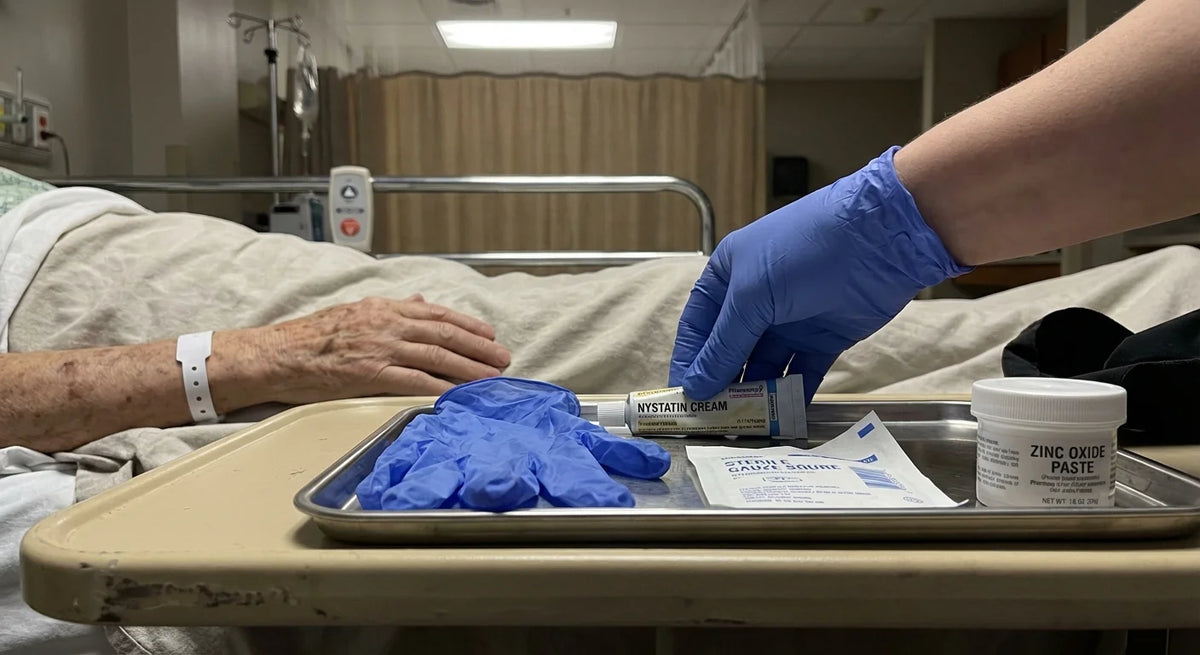
Doctors see your skin fold for 10 seconds during a 15-minute appointment. I see it for 12 hours during a shift.
I'm the one who actually LOOKS at the rash. I'm the one who lifts the fold, cleans it, applies the cream, and documents what I see. The doctor reads my notes, writes the prescription, and moves on. I'm the one who sees it fail.
Here's what I see every single shift that your doctor doesn't:
The cream stays wet. I apply Nystatin to a patient's skin fold at 7 AM. By 9 AM, the fold is wetter than before I applied it. The antifungal cream adds moisture to a fold that's already too moist. I'm watching the treatment make the environment worse in real time.
The powder turns to paste. I've watched Gold Bond absorb sweat for about an hour, then mix with body heat and moisture into a gritty paste that sits against raw, cracked skin. I've cleaned that paste out of folds. It's not helping. It's creating friction and trapping heat.
The rash always comes back. I chart "improvement" after a few days of treatment. The doctor sees the note and thinks it's working. But I see the same patient two weeks later with the same rash in the same fold — sometimes worse. The treatment didn't fail because the patient did something wrong. It failed because it only addressed one part of the problem.
Patients stop reporting it. After being dismissed twice, most women stop bringing it up. They manage it silently — powder in the morning, bathroom checks every two hours, blow dryer at home. They've learned that the medical system doesn't have an answer. So they stop asking.
I see this cycle on repeat. Every shift. Every week. For 14 years.
WHAT'S ACTUALLY HAPPENING IN YOUR SKIN FOLD
Let me explain this the way I explain it to patients when I actually have time — which is usually during a night shift when things are quiet and I can sit down.
Your skin fold rash is not just irritation. It's not a heat rash. It's not because you're not clean enough — I've seen women who shower twice a day develop severe intertrigo.
It's a fungal infection. Specifically, a yeast called Candida that colonizes the warm, moist, dark environment where skin presses against skin.
Here's why it won't go away:
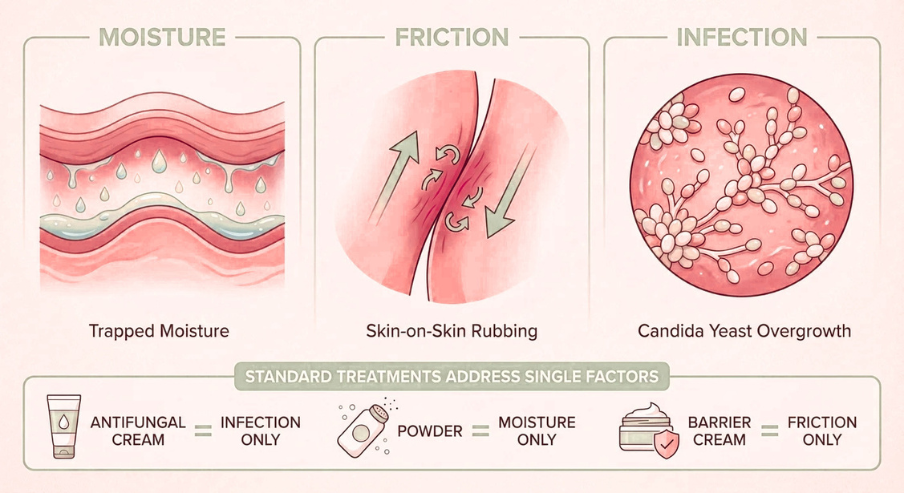
Three things are happening at once in the same fold:
1. Moisture. Sweat gets trapped in the fold with zero airflow. The skin stays wet all day — creating the perfect breeding ground for Candida. This is worse for nurses, teachers, retail workers, and anyone who spends hours on their feet in warm environments.
2. Friction. Skin rubs against skin with every step, every shift in your chair, every breath. The tissue gets raw and cracked — opening the door for deeper infection.
3. Fungal infection. Candida colonizes the warm, wet fold. It feeds on the moisture. It multiplies. It penetrates the tissue surface. And it produces the burning, the itching, the cracking, and the smell.
Every product on the standard protocol addresses ONE of these. Antifungal cream handles infection — while adding moisture. Powder handles moisture — until it turns to paste. Barrier cream handles friction — while trapping heat and sealing in the fungal environment.
In 14 years of nursing, I have never seen a standard protocol that addresses all three simultaneously.
Until I found one on my own.
WHY THE STANDARD PROTOCOL FAILS
I need to be direct about this, even if it makes my colleagues uncomfortable.
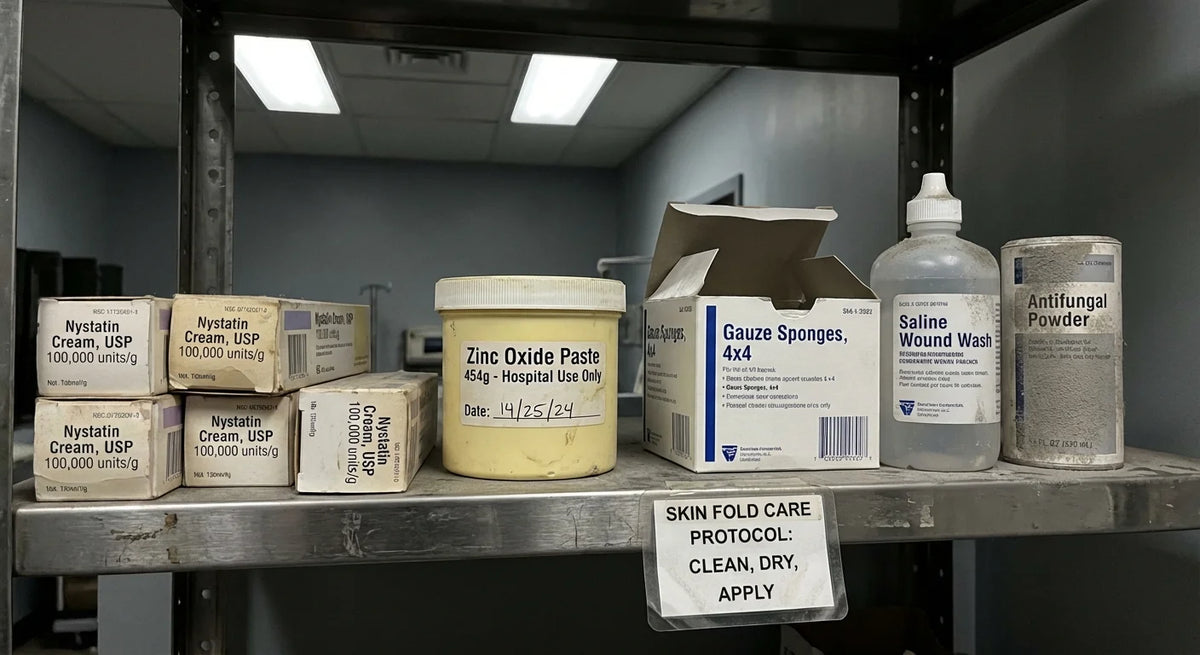
Nystatin was developed in 1950. The formulation hasn't fundamentally changed. It kills some surface-level Candida — but it's a wet cream applied to a wet fold. In my clinical experience, it provides 3-5 days of partial relief before the rash returns. I've charted this pattern hundreds of times.
Lotrimin was designed for athlete's foot. Feet have air exposure. The cream base evaporates. A skin fold is the opposite — compressed, sealed, zero airflow. The cream stays wet. The fungus retreats temporarily and returns when conditions are right. I've watched this cycle in my patients and in my own skin.
Steroid creams thin the skin. I've seen patients on long-term hydrocortisone develop skin so thin it tears from normal friction. The steroid reduces inflammation temporarily — but it doesn't kill the infection causing it. And it makes the skin more vulnerable to the next flare.
"Keep it clean and dry" without a mechanism is meaningless. I've told patients this myself because it's what the protocol says. But the body produces moisture in that fold continuously. Without a product that keeps the fold dry past noon, "keep it dry" is an instruction without a tool.
The protocol doesn't fail because nurses and doctors don't care. It fails because the products we have weren't designed for the problem we're treating.
I knew this for years. I just didn't have an alternative to offer — until I tried one on myself.
WHAT I USE ON MY OWN SKIN — AND IT'S NOT WHAT WE STOCK ON THE FLOOR
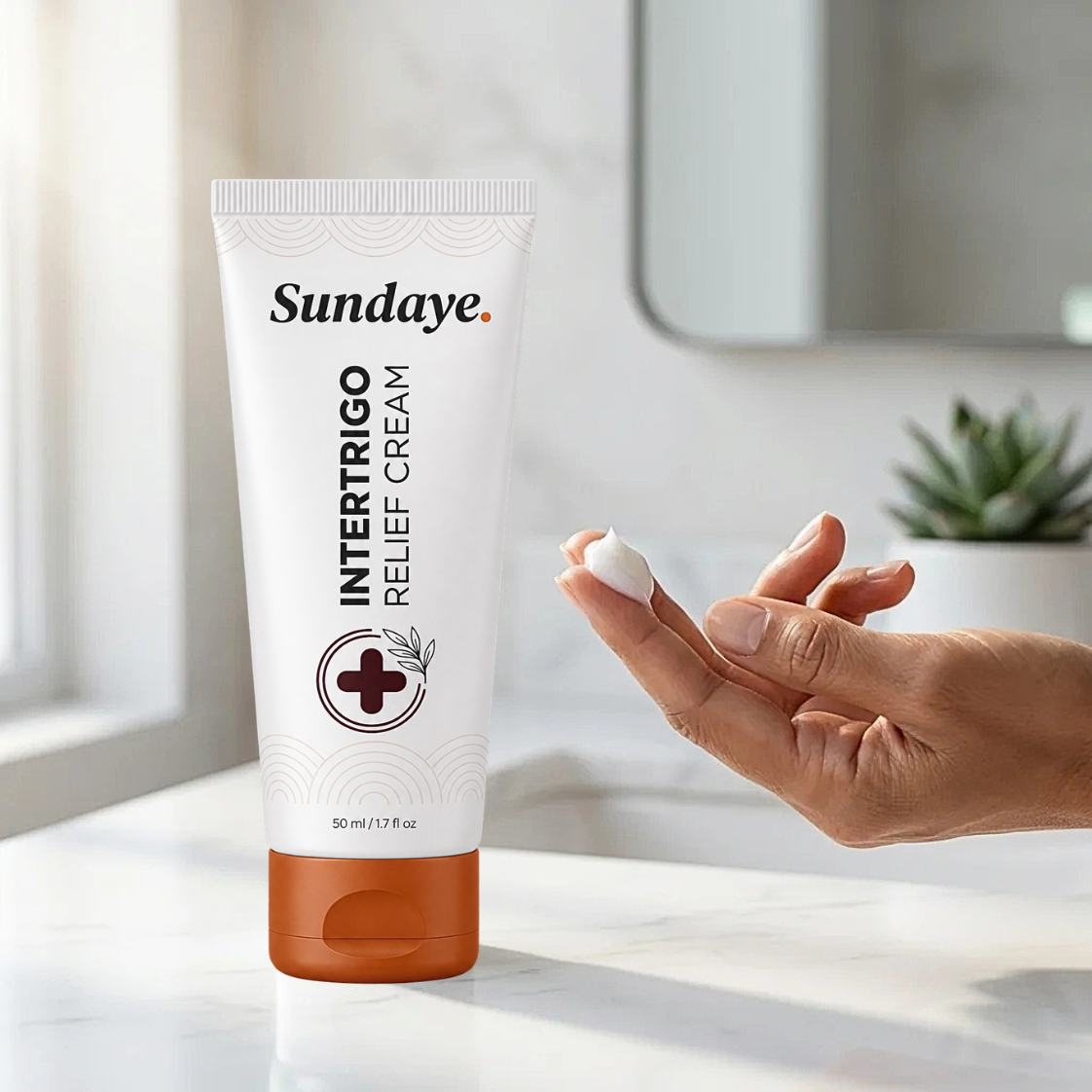
I found Sundaye Intertrigo Relief Cream the same way most women do — by searching on my own after the standard options failed.
I was skeptical. I'm a nurse. I read ingredient labels. I look up clinical mechanisms. I don't buy things because of marketing — I buy things because of pharmacology.
Here's what made me try it: the formulation addresses all three factors simultaneously. Not one. All three. In 14 years of nursing, I'd never seen that in a single product.
Phase 1 — Immediate Relief (0-24 hours): Witch hazel shrinks moisture on contact. The fold goes from damp to dry in minutes — not an hour, not "gradually." Minutes. Zinc oxide (15%) creates a breathable barrier that stops friction immediately. The first time I applied it before a 12-hour shift, I felt the difference by hour 2. By hour 8, I was still dry. That had never happened.
Phase 2 — Infection Elimination (Days 1-5): Undecylenic acid at 10% — clinical strength. This is the ingredient that separates Sundaye from everything else I've tried. It prevents Candida from transforming into its invasive, tissue-penetrating form. That transformation is why the rash keeps coming back — surface treatments kill the surface colony, but the invasive form survives and recolonizes. Undecylenic acid stops that mechanism. I understood why immediately — as a nurse, I've studied the fungal lifecycle. This is the step that standard protocols miss entirely.
Microencapsulated tea tree oil provides continuous antimicrobial protection without stinging. I've had patients scream when I applied straight tea tree oil to raw skin. The microencapsulation releases it gradually. No burn. No sting. That matters when your skin is already cracked and weeping.
Phase 3 — Barrier Restoration (Days 5-7): The skin barrier regenerates under a powder-dry protective environment. pH correction restores the fold's natural acidic state — hostile to Candida. This is the prevention phase. Not days of relief. Months.
I applied it before my shift on a Monday. By Thursday, the rash that had been cycling for 6 years was visibly clearing. By the following Monday, it was gone. It's been 5 months. It hasn't come back.
I don't use what we stock on the floor anymore. I use this.
THE 2 THINGS I WISH THE SYSTEM WOULD CHANGE
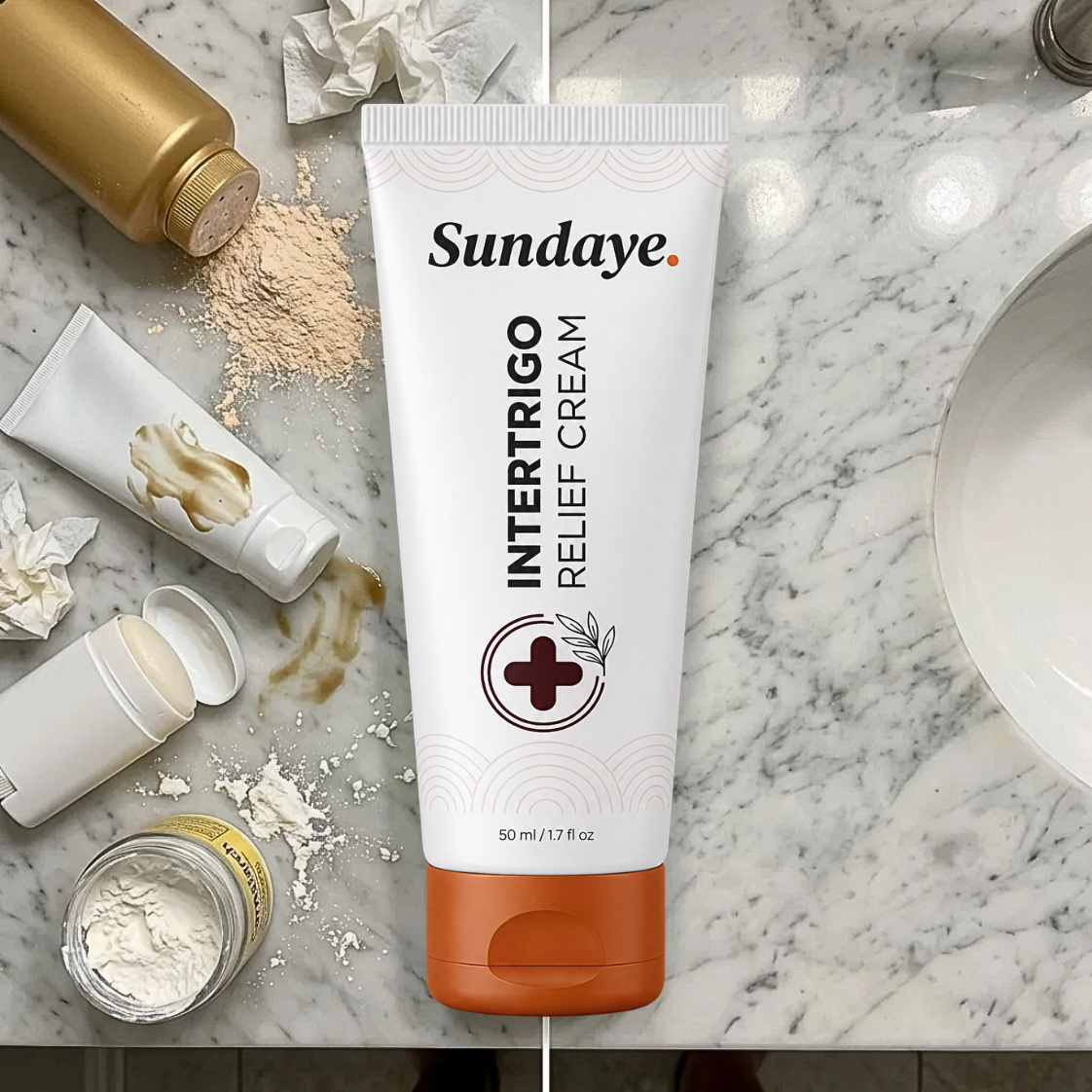
1. We need to stop prescribing wet creams for wet folds.
This is the most basic pharmacological mismatch I see in clinical practice. A skin fold rash is a moisture problem. Nystatin and Lotrimin are wet cream formulations. We are adding moisture to a condition caused by moisture. I've raised this in staff meetings. Nothing changes.
Sundaye goes on like a cream and dries to a powder-like finish in 60 seconds. It addresses the moisture problem instead of adding to it. This should be the standard — not a cream formulated for feet in 1975.
2. We need to treat the fold as an environment, not just the infection.
The protocol treats the fungus. Just the fungus. But the fungus is a symptom of the environment — the moisture, the friction, the pH imbalance, the heat. Kill the fungus without changing the environment and the fungus comes back. Every time.
Sundaye changes the environment. It dries the moisture, creates a friction barrier, kills the infection, and restores the pH. The rash doesn't come back because the fold is no longer a hospitable environment for Candida.
This is what 14 years of clinical observation taught me. The protocol treats the symptom. Sundaye treats the system.
WHAT MY PATIENTS ARE SAYING — AND WHAT I'M SAYING
★★★★★ 4.9 | 3,847+ Customers | Recommended
I'm an RN. I've tried every product in the Pyxis and every product at CVS. This is the first one I use on myself AND recommend to my patients off the record.
— Sarah C., RNMy nurse at my last checkup saw me scratching under my bra and quietly told me about this. She said 'I use it myself.' That's how I knew to trust it.
— Diane M.I work 12-hour shifts in a hospital kitchen. By hour 6, the powder was paste and I was in agony. Sundaye lasted my entire shift. I cried in the break room — not from pain, from relief.
— Patricia W."I'm a CNA. My charge nurse told me about it. I've been using it for 4 months. It's the only thing that survived a full shift without reapplication. Get the 3-pack."
— Patricia W. — Can a nurse actually recommend this? Is it legit?"14 years as a nurse and I was using baby cream on my own skin. The irony is not lost on me. Sundaye ended that embarrassment.
— Linda G.90-DAY MONEY-BACK GUARANTEE

I'm a nurse. I don't recommend things I don't trust. And I wouldn't put my professional reputation behind a product that doesn't work.
Sundaye gives you 90 days — not 30. Three full months. Use it through a full shift rotation, through summer, through your worst flare-up. If it doesn't work, full refund. No return shipping. No restocking fee. No questions.
No prescription needed. No co-pay. No appointment. No waiting room.
I use it every day before my shift. I haven't had a flare-up in 5 months. That's my testimony — not as a spokesperson, but as a woman who spent 6 years suffering from the same condition I treated on other people every single day.
⚠️ IMPORTANT: PURCHASE ONLY FROM THE OFFICIAL WEBSITE
- Sundaye is available only at the official manufacturer's website.
- If you see it on Amazon, eBay, or any third-party site, it is not our product. We've identified counterfeit listings with unknown ingredients that haven't been tested.
- As a nurse, I can tell you: do not put an unverified formula on broken, raw skin. You don't know what's in it. I wouldn't use it on a patient, and I wouldn't use it on myself.
 APPLY DISCOUNT & CHECK AVAILABILITY
I've been a nurse for 14 years. I've treated skin fold rashes on thousands of patients. I've charted "recurrent intertrigo" more times than I can count. I've applied Nystatin knowing it would fail. I've told patients to "keep it clean and dry" knowing the instruction was incomplete.
And I've lived with the same rash myself — under my scrubs, through 12-hour shifts, for 6 years.
The system gave me the same tools it gives everyone. They weren't enough. Not for my patients, and not for me.
Sundaye was the first product I found that matched what I knew clinically. Three factors. One product. An environment solution, not just a symptom treatment.
I'm not telling you this because anyone asked me to. I'm telling you because I spent 6 years as a nurse who couldn't fix her own skin — and I don't want you to spend one more day stuck in the same cycle.